
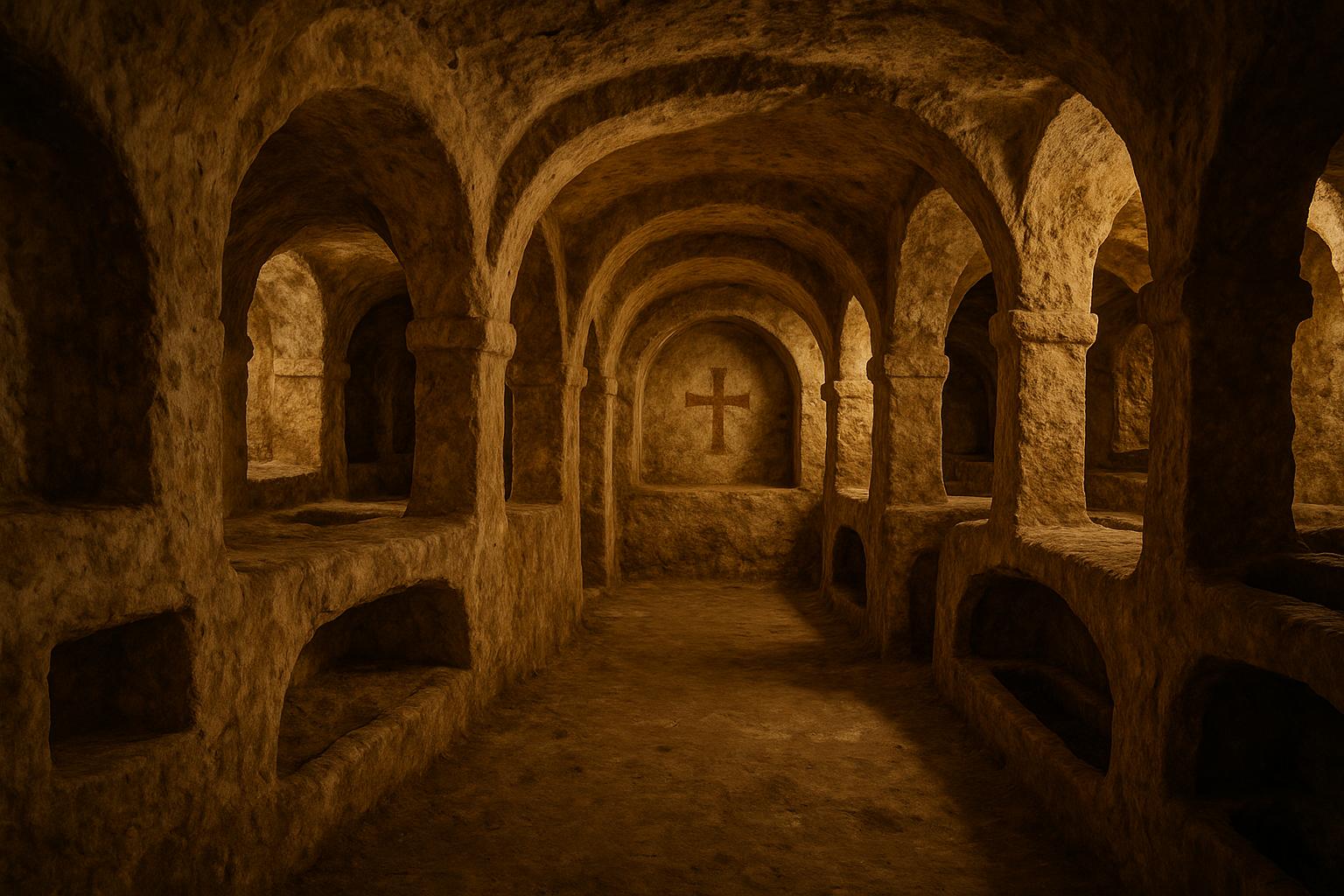
Overview of St. Agatha’s Catacombs
St. Agatha’s Catacombs, located in the historic town of Rabat, Malta, represent an enthralling network of underground burial sites that trace their origins back to the early Christian era. These ancient catacombs are an integral part of Malta’s rich cultural and religious tapestry, offering an immersive view into the burial customs of the early Christians as well as the historical milieu of the island. The site stands as a testament to Malta’s deep-seated religious tradition and its evolution across the centuries.
Historical Significance
The catacombs are believed to have been active since at least the 3rd century AD. This period was marked by significant religious transformation and turmoil, reflecting the broader contours of history during the early days of Christianity. Tradition holds that St. Agatha, a revered Christian martyr known for her devotion and resilience, sought refuge within these underground passages to escape Roman persecution. Her association with these catacombs highlights the catacombs’ use as a sanctuary during times of religious persecution and civil strife. This attribute significantly elevates their importance as a historical monument within Malta, offering insights into the lives and challenges faced by early Christians on the island.
Architecture and Design
The architectural design of St. Agatha’s Catacombs showcases the resourcefulness and inventive capabilities of early Christian communities. Carved meticulously into the soft Maltese limestone, the catacombs comprise an intricate network of galleries and tombs. The soft yet durable nature of the limestone provided an ideal medium for construction and preservation. The walls are graced with faint frescoes, which although faded with time, provide invaluable insights into early Christian iconography. These frescoes serve as cultural artifacts reflecting artistic traditions and religious symbols of that era. The artwork ranges from simple decorations to intricate religious symbols, each conveying a story and offering a snapshot into the past religious sentiments and artistic expressions.
Structurally, the catacombs are a marvel of ancient engineering, with their ability to sustain historical continuity over centuries. The meticulous design involves not just individual tombs but also vast communal galleries, emphasizing the communal nature of early Christian societies. Each corridor and chamber tells a story of a community joined not only in life but also in death, illustrating the cultural and societal values that emphasized unity, family, and spiritual cohesion.
Exploring the Catacombs
Visitors embarking on a journey through St. Agatha’s Catacombs have the opportunity to navigate its winding paths and subterranean chambers. The exploration provides a visceral journey back in time, revealing how the catacomb’s design is interwoven with the communal burial practices of early Christians. As one delves deeper into the catacombs, the presence of family tombs becomes apparent, underscoring the cultural emphasis on family unity even in death—a poignant reminder of the societal values that prevailed among the early Christians.
Each chamber and passageway is more than a mere structural element; it represents the coming together of familial and social bonds. The arrangements within the catacombs often show families buried together, reflecting a collective approach to both life and death. This approach is demonstrative of early Christian beliefs about life after death, with the familial structure forming an integral part of their spiritual journey.
Preservation and Access
The preservation of these catacombs is of paramount importance, both as a religious site and as an archaeological treasure. There have been concerted efforts to maintain the integrity of the site and its historical artifacts. This involves the implementation of strategies to minimize damage caused by environmental exposure and human interaction. For those interested in exploring this historical site, the catacombs of St. Agatha are accessible through guided tours. Such tours are often led by knowledgeable guides who ensure that visitors gain meaningful insights into the site’s history while also respecting the sensitive nature of the ancient burial site.
These guided tours provide not just educational value but also regulatory oversight, ensuring that the site’s sanctity is respected. The management of visitor access through structured tours helps in maintaining the catacombs’ condition, safeguarding it for future generations to continue experiencing this remarkable piece of history. For additional information regarding visiting hours and tour details, potential visitors can consult the official site of the St. Paul’s Catacombs Heritage Malta. This provides an excellent resource for planning visits and ensuring a comprehensive understanding of the catacombs’ historical context.
Conclusion
St. Agatha’s Catacombs offer more than a mere glimpse into early Christian burial practices—they provide an encompassing narrative about Malta’s historical and cultural evolution. This quintessential landmark is pivotal not only from a religious perspective but also from an archaeological standpoint, continuing to attract scholars and tourists alike who are eager to delve into its ancient corridors and uncover the stories encapsulated within its walls.
As one of Malta’s most significant religious and historical sites, the catacombs of St. Agatha continue to function as a bridge connecting the past with the present. They offer modern-day visitors not merely a look into early Christian practices but also an invitation to understand the perseverance and resilience that have characterized Malta’s history. As such, the catacombs are not only a repository of past traditions but also an active participant in the dialogue surrounding cultural and historical identity, ensuring that the legacy of those who sought refuge and eternal rest within its chambers continues to resonate through the ages.